The SEO World Is in Shock—But I’m Not
If you’ve been online in the last month, you’ve seen the panic.
Marketers, business owners, and even “SEO gurus” are all scrambling to figure out what just happened to Google. Once again, a core update has rewritten the playbook—sites that dominated search have vanished overnight, while obscure competitors quietly climb to the top.
You might be wondering:
“Did Google really change the rules overnight?”
The short answer is no.
The real answer: Google’s shift started over a decade ago.
And if you’ve followed me, you already saw it coming.
This is not a “told you so.” It’s a blueprint for anyone tired of algorithm whiplash—because there’s a system that still works, even as Google keeps moving the goalposts.
Why Most SEO Advice Feels Broken (And What Everyone Missed)
Let’s rewind to 2015.
SEO at the time was still obsessed with keywords, backlinks, and gaming the system. The loudest voices on YouTube, Twitter, and in endless $997 courses all promised quick fixes:
- Stuff more keywords.
- Buy more links.
- Create endless spun content.
But quietly, something started to change.
I noticed small, almost invisible websites overtaking giants—sometimes overnight. Not because they had more backlinks or “authority,” but because their visitors behaved differently:
- Users actually read their content, not just clicked and bounced.
- They scrolled, explored, and returned days or weeks later.
- Time-on-site went up.
- Engagement signals shot through the roof.
At first, most “experts” called it luck.
But I knew better: Google had started to reward behavioral SEO.
What Is Behavioral SEO? (And Why It Matters More Than Ever)
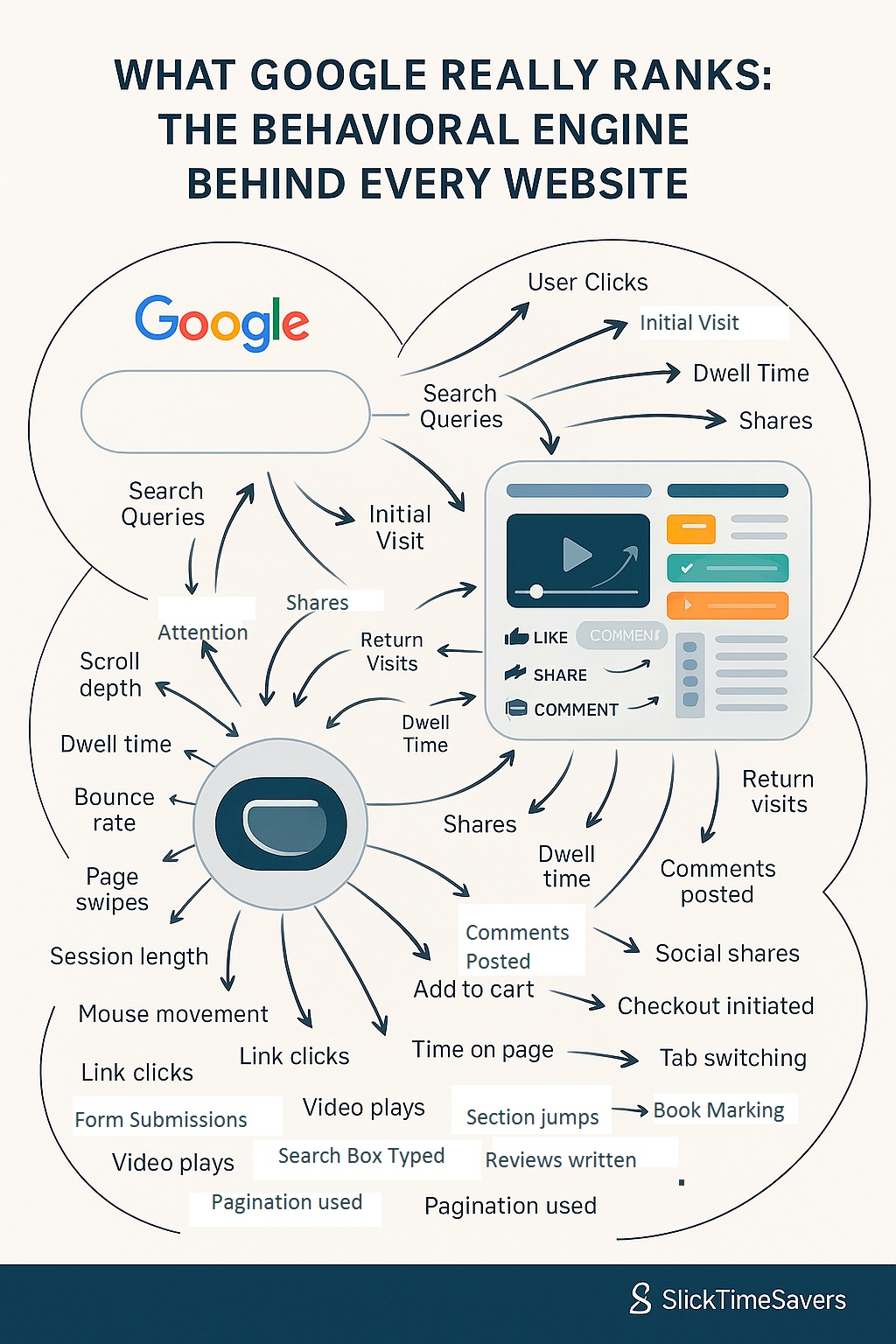
Behavioral SEO is not a buzzword.
It’s the fundamental shift that powers every search result you see today.
Instead of just analyzing links and on-page signals, Google’s algorithm has become a behavioral engine. It measures how real humans interact with your website:
- Dwell Time: How long do visitors actually stay?
- Scroll Depth: Do they skim the top, or read all the way down?
- Click-Through Rate: Are people choosing your site from search results, or skipping past you?
- Return Visits: Do people come back for more?
- Engagement: Are users sharing, commenting, or taking action?
This isn’t speculation.
For over a decade, I’ve monitored and reverse-engineered these signals—building tools, running real experiments, and quietly watching small, intent-driven websites outpace the “big brands” everyone thought were untouchable.
The result?
Sites optimized for human behavior—not just bots or links—consistently win.
The 2025 Update Didn’t Change the Game. It Just Made the Truth Obvious.
Let’s talk about Google’s 2025 update.
Yes, it’s big.
Yes, it’s disruptive.
But it’s only “new” if you weren’t paying attention.
This update simply amplified what started a decade ago:
- Thin, keyword-stuffed pages got wiped out.
- Authority based on backlinks alone no longer guarantees page one.
- Sites that keep real users engaged are being rewarded like never before.
Suddenly, the world is panicking.
But if you’ve built your SEO the way I teach—focusing on intent, engagement, and repeat human visits—this is just business as usual.
In fact, if you were already following the behavioral SEO blueprint, you probably gained ground.
Real-World Proof: Quiet Wins, Not Noisy Hype
I’ve lost count of how many times I’ve seen someone pour their heart, money, and time into a site—only to watch it tank because they followed outdated “guru” advice. The frustration is real.
But I’ve also watched:
- Micro-sites in boring niches quietly climb to the top.
- Directory websites with zero “brand recognition” outrank household names.
- Lean teams and solo entrepreneurs outrun deep-pocketed corporations—because their sites were built for humans, not algorithms.
Let’s be clear:
Google is not “out to get you.”
It’s out to satisfy users. If your site actually helps, delights, or solves a real problem—and you design for the behavior Google now tracks—you win.
So What Actually Works Now? (The Blueprint I’ve Used for Years)
Here’s the system that survived every Google update for the past decade:
1. Build for Intent, Not Just Keywords
Ask: What does the searcher truly want?
Design your site so they get it—fast. Answer the real question. Solve the problem. Don’t distract, overcomplicate, or trick users.
2. Structure for Engagement
Pages that keep people reading, scrolling, and clicking around are the real SEO winners. Use:
- Clear subheadings (just like this post).
- Internal links to relevant content.
- Visual cues and CTAs that encourage further exploration.
3. Encourage Return Visits
Give people a reason to come back:
- Offer free tools, templates, or checklists.
- Update content regularly (not just “add more keywords”).
- Use email or notifications to bring people back to your ecosystem.
4. Track Real Behavior (Not Vanity Metrics)
Don’t just count visits. Watch what people actually do on your site.
Which pages have high scroll depth?
Where do users drop off?
Where do they linger and engage?
This is your roadmap for improving—and ranking.
5. Stay Evergreen—Build Assets, Not Just Pages
Directories, guides, resource hubs, and problem-solving articles will always have value.
Trends come and go, but assets built for genuine needs and behaviors compound in value over time.
Why I Focus on Directory Websites (And Why You Should Too)
You might wonder why I keep emphasizing directory-style sites.
Simple:
They are behavior magnets.
- Visitors browse, compare, and return often.
- These sites naturally generate repeat engagement—exactly what Google wants.
- You’re not fighting for “content freshness” or endless viral traffic.
- You quietly build authority by solving real problems, not shouting for attention.
And yes—directories still work in 2025, even as AI-generated content floods the web. If you know how to structure and optimize them for behavioral signals, you’re insulated from nearly every algorithm update.
Why Most “Quick Fix” SEO Tactics Fail (And What to Do Instead)
Every year, a new “SEO hack” makes the rounds.
Chase it and you’ll burn out. Ignore the noise.
Here’s what Google’s own actions reveal:
- Engagement > Backlinks
- Experience > Authority (when authority is just a number)
- Real Value > Trickery
If you want compounding results, you need a system designed for the long run.
The Quiet Advantage: How to Future-Proof Your Rankings
Ask yourself:
- Is my site designed for real people, or just for search engines?
- Am I delivering value in a way that encourages action, engagement, and repeat visits?
- Do I understand the why behind each page’s ranking—or just hope for the best?
The answer is your future.
The new SEO is not about gaming the algorithm. It’s about creating systems that naturally fit what Google already wants to reward.
If you’re ready to break free from the SEO rollercoaster and build an asset that quietly grows in value—no matter what Google does next—
I’ve documented my full step-by-step blueprint.
You’ll learn:
- How to design sites Google can’t ignore (because users love them).
- How to pick topics and structures that guarantee return visits and engagement.
- The exact workflow I use to launch, scale, and protect directory websites—even in 2025’s AI-saturated world.
Curious?
Download the Directory Website Blueprint now and see why the new SEO game was always about behavior.
Final Word
Ten years ago, I saw this shift coming.
Today, everyone’s scrambling—but you don’t have to.
Build for humans. Optimize for behavior.
That’s the only “secret” left.