Introduction: The Game Has Changed, Quietly
If you’re still obsessing over keyword density or chasing backlinks like it’s 2012, it’s time for a reality check. The world of search—and the invisible mechanics behind how people find, trust, and return to your website—has shifted. Most marketers haven’t noticed yet. They’re too busy “optimizing” for yesterday’s Google, oblivious to the fact that both Google and AI search engines are quietly re-ranking the web based on a very different set of signals.
The new era isn’t about who shouts the loudest or spends the most. It’s about who quietly, reliably satisfies intent—again and again. And that’s exactly what SlickTimeSavers.com is built to help you do.
From Backlinks to Behavior: What Google Really Rewards Now
For over a decade, SEO professionals have lived and died by backlinks. Build enough authority, get enough big-name sites to link to you, and Google would reward you with traffic. The entire “industry” of SEO content, guest posting, and link exchanges blossomed from this single insight.
But here’s the part the big-name gurus won’t say out loud: Google’s core ranking engine is no longer dominated by backlinks. It’s dominated by behavior.
What does that mean in plain English?
- Google is watching what real users do on your site.
- If people land, click, scroll, and return, your site earns invisible trust.
- If they bounce, hesitate, or seem unsatisfied, you’re quietly marked as “not the answer.”
This isn’t theory or speculation—it’s happening now, right under the nose of most marketers.
Featured Answer:
Google’s most important ranking signals today are user interactions: clicks, scrolls, time on site, and return visits.
Enter AI Search: Your Content is Now “Training Data” for Answers
If you think this shift only matters for traditional Google rankings, think again.
AI models—like ChatGPT, Perplexity, and Google’s own AI Overviews—are hungry for high-quality answers. They don’t care if your content is “optimized” in the old-school sense. They care if your writing is clear, factual, and directly answers a real question.
Your content is no longer just web copy. It’s AI answer fodder. If you want your brand to be seen, cited, and surfaced in the new generation of AI-powered search, your website needs to “speak” both to humans and to machines.
How do you do that?
- Write in clear, declarative sentences.
- Structure your information so it can be lifted out as an answer.
- Cover intent fully—don’t just bait for clicks.
- Include Q&A or summary sections that AI can extract as direct answers.
Behavioral SEO in Practice: What Really Works Now
Let’s break down the practical side. Here’s what actually matters in 2025 and beyond:
1. Satisfy Search Intent—Completely
Every search query is a question, a pain point, or a curiosity. The sites that win are the ones that fully answer the intent behind the search, not just the literal query.
- If a user lands on your site looking for a solution, deliver it instantly.
- Use clear headlines, summaries, and direct answers.
- Don’t bury the lede; give people what they came for first, then expand with detail.
2. Engagement Signals Matter More Than Ever
Google and AI models watch:
- Clicks: Are users choosing your site over others?
- Scroll Depth: Are they exploring your page or bouncing instantly?
- Time on Page: Are they actually reading or just skimming and leaving?
- Return Visits: Do people come back for more, or do they never return?
Each positive signal increases your trust score—often invisibly, but powerfully.
3. Behavioral Design: Invisible Conversion Triggers
The way you design your site and content has a direct impact on these signals.
- Make content easy to scan with headers, bullets, and callouts.
- Use images and charts to break up text and keep people moving.
- Include “open loops” (hints at deeper insights or answers further down the page) to encourage scrolling.
4. Content Structure for AI Extraction
Start thinking like an AI:
- Summarize big ideas at the top.
- Use Q&A boxes, checklists, and step-by-step guides.
- Repeat important facts and conclusions in slightly varied language.
The goal: Make it easy for both Google and AI to surface your content as “the answer” for any relevant query.
The Myth of Authority: Why Small, Intent-Focused Sites Quietly Win
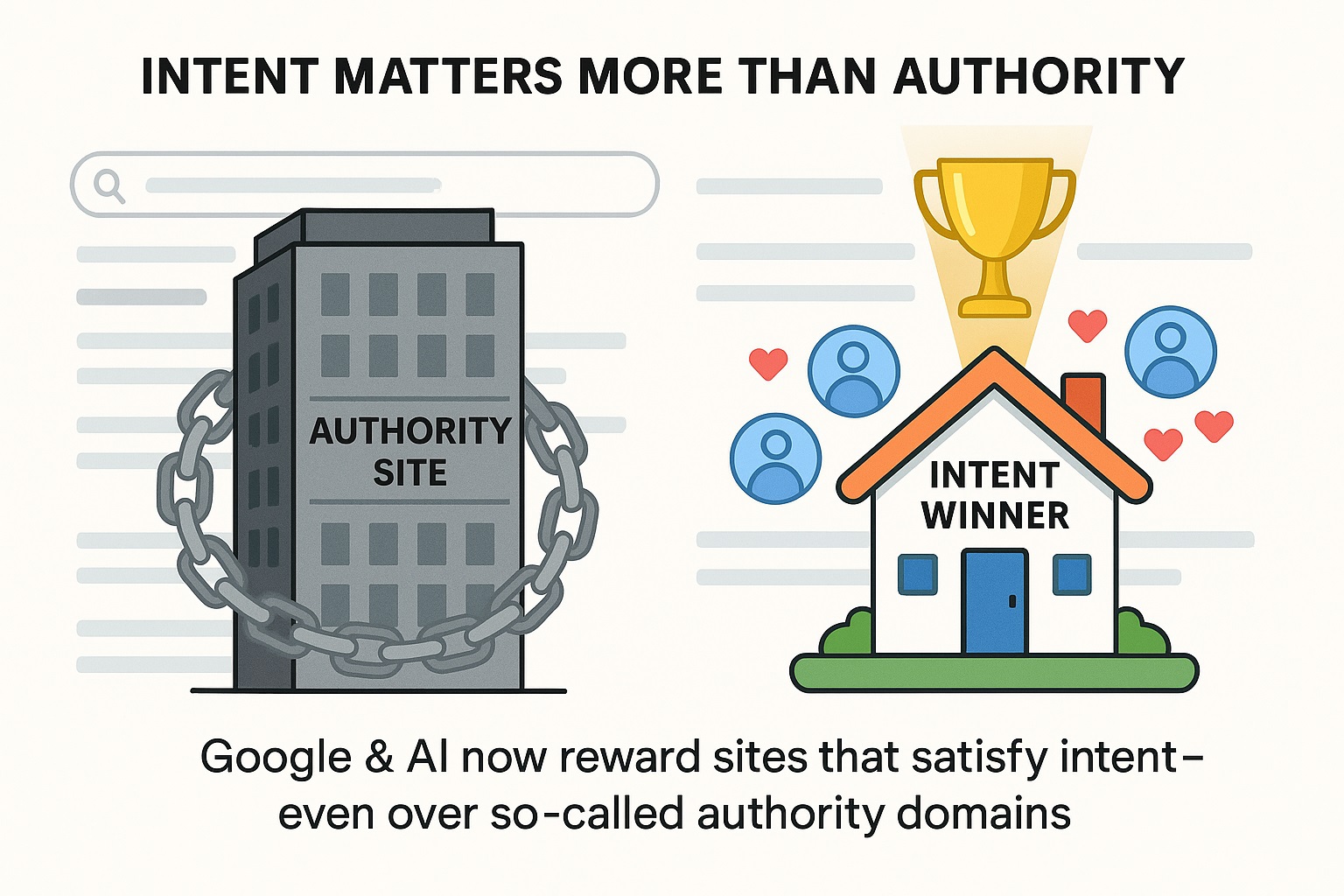
You don’t need to be a giant in your niche. In fact, smaller, intent-focused sites are thriving right now—precisely because they’re better at satisfying intent than bloated “authority” domains.
Google’s behavioral algorithms are designed to detect when a small site is quietly outperforming a big brand. If your content keeps users happy and returning, you can outrank sites with ten times the links and budget.
Case in Point:
Many of the fastest-rising sites in obscure niches are micro-directories, guides, or resource hubs—built not for show, but for substance. They answer, they deliver, and they win.
AI Search Is Forcing a Level Playing Field
Here’s a little-known fact: AI search doesn’t care who you are. It cares how well you answer the question.
That means your content, no matter how “small” your brand, can be surfaced as the best answer—if it’s written for both people and machines.
AI looks for:
- Direct answers
- Up-to-date, factual info
- Clear, unambiguous language
- Signals that real people trust and use your content
If you optimize for these, you’re future-proofing your visibility no matter how the platforms evolve.
Action Steps: How to Make Your Content “AI & Behavior-First” Today
Let’s make this actionable. Here’s how you can align your site for the new era:
1. Audit Your Content for Intent Satisfaction
- Does every page answer a clear, real question?
- Can a visitor get what they came for in the first 10 seconds?
2. Restructure for Extraction
- Add a Q&A section to every page.
- Use bullet points, numbered lists, and summary boxes.
- Include a TL;DR (Too Long; Didn’t Read) summary at the top.
3. Improve Behavioral Signals
- Add “Read Next” suggestions at the bottom of posts to keep people moving.
- Make navigation intuitive; avoid dead ends.
- Embed interactive elements (polls, quizzes, calculators) where appropriate.
4. Write With AI in Mind
- Use “featured answer” phrasing: Short, direct, fact-first sentences.
- Repeat key points in different ways.
- Include your target questions as H2 or H3 headers.
5. Monitor User Engagement
- Use analytics to track scroll depth, time on page, and bounce rates.
- Identify pages where people “drop off” and refine them for clarity and intent.
The Quiet Advantage: Why SlickTimeSavers.com Embraces This Shift
At SlickTimeSavers.com, we’re not here to help you “game” Google with gimmicks. We believe the future belongs to the quiet experts, the resource builders, the creators who solve real problems for real people.
Our guides, tools, and systems are all built on the same foundational principle:
If you satisfy intent and design for user behavior, you win—quietly, steadily, and with staying power.
Whether you’re running a micro-directory, launching a new info product, or building a resource hub, the rules have changed. But the path to long-term, compounding traffic and authority has never been clearer.
Soft Call to Action
Ready to future-proof your online presence?
If you’re tired of chasing trends and want a proven blueprint for quiet, compounding wins—built for both Google and AI search—explore our behavioral SEO systems and guides here.
Or, if you want a personal review of your site’s “behavioral health,” reach out.
Let’s make your content answer-ready for the next decade of search.
Summary:
- SEO is now about satisfying real users, not gaming algorithms.
- AI search engines value clear, direct, intent-focused answers.
- Small, behavior-first sites can quietly outrank the giants.
- Align your content for both human engagement and AI extraction to win now—and in the future.
Ready to build something that lasts?
We’re here for the quiet winners.